
How to Choose the Right Packaging Machine for Different Product Types
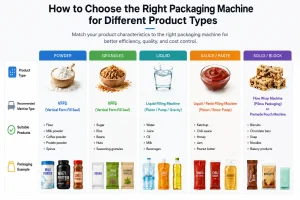
Short answer: Choose the machine by the product, the finished package and the required operation. Measuring a dose, making a bag, sealing a tray and loading a carton are different tasks. Confirm which tasks the quoted equipment performs before comparing speed or filling range.
Start with the product and package
Describe the product as it will enter the machine: powder, free-flowing granules, liquid, paste or an individual solid item. Then specify the finished package, including its dimensions, material and closure. A product category alone does not define the complete packing line.
| Requirement | A configuration to review | What to confirm |
|---|---|---|
| Powder dosing | QT-F2 auger powder filler | Powder flow, target weight, tolerance and the container or bag. |
| Granule portions | RWP-6 weighing and pouch-packing setup | Particle size, product handling, dose and pouch construction. |
| Liquid in bottles | TLF-04 liquid filler | Fill volume, liquid behavior, bottle opening and the separate closure step. |
| Sauce, cream or paste | GT-500 paste filler | Product at filling temperature, particles, nozzle and container. |
| Individual solid item | DZB-350 pillow packing machine | Product orientation, infeed stability, bag space and sealing film. |
| Prepared food in trays | TSM-10 tray packing machine | Tray rim, lidding film, mold, loading and the required atmosphere. |
These are examples from the rafaepacking catalogue, not a guarantee that one standard setup suits every product in a category. Confirm the actual configuration using product and packaging samples.
Separate dosing from package formation and closure
A filler measures product into the selected package. The surrounding equipment may also need to form a bag, position a container, cap a bottle or seal a pouch. List these operations in order and identify which are included in the quotation.
A premade bag filling and sealing machine works with already-formed pouches. A VFFS machine makes bags from roll film. Compare those processes in the premade pouch and VFFS guide.
Compare output under the same conditions
Use the same product, dose, package size and acceptance criteria when comparing equipment. Ask for the rate of acceptable finished packs, including the planned loading and unloading method. A maximum cycle rate does not describe every production setup.
For several products or formats, confirm the parts, settings, cleaning and changeover steps required for each one. Automatic filling or sealing does not by itself mean that every surrounding handling step is automatic.
Prepare an enquiry that can be checked
- Product name, photographs, sample and relevant flow or handling characteristics.
- Target fill weight or volume, acceptable tolerance and required finished-pack output.
- Package dimensions, material, closure and a finished-pack sample.
- Available power, compressed air if required, installation space and loading method.
- Cleaning, changeover and product-contact requirements.
For powders, use the powder filling-system guide. For prepared foods, compare tray sealing and vacuum packaging before specifying the machine.