
Premade Pouch Packaging vs VFFS: What Is the Difference?
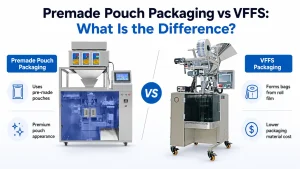
Short answer: A premade pouch machine fills and seals pouches that have already been made. A vertical form-fill-seal (VFFS) machine forms bags from a roll of film, fills them and seals them during the packaging process. The right choice depends on the required package, product, output and operating costs.
Premade Pouch and VFFS Comparison
| Selection point | Premade pouch machine | VFFS machine |
|---|---|---|
| Packaging supplied | Finished empty pouches. | Roll film that the machine forms into bags. |
| Handling to confirm | Pouch pickup, opening, filling and closing. | Film feeding, forming, filling, sealing and cutting. |
| Format details | Pouch dimensions, construction and features such as a zipper. | Film width and structure, forming parts and the finished bag dimensions. |
| Changing products or sizes | Confirm pouch-handling parts, filler settings and seal adjustments. | Confirm forming parts, film settings, filler settings and seal adjustments. |
| A fair comparison | Use the same product, dose, package requirement and acceptance criteria. | Use the same product, dose, package requirement and acceptance criteria. |
How does each machine make a package?
A premade pouch system works with finished empty pouches. The pouches are positioned for filling and then sealed. Their size, construction and features must be compatible with the pouch-handling and sealing equipment.
A VFFS system feeds roll film through a forming section, measures or doses the product, and seals and cuts the film into individual bags. The dosing system and forming parts must match the product and package specification.
When should you consider a premade pouch machine?
Premade pouches can be a practical choice when you already use a particular pouch design or need a specific retail presentation, such as a compatible stand-up pouch. Check whether the chosen machine can handle the pouch dimensions, material, opening and any zipper before ordering.
For example, the SPK-500 premade bag filling and sealing machine is listed at 15–30 bags per minute with pouch lengths of 120–300 mm and widths of 100–200 mm. Its product page lists a customizable filling capacity of 10–500 ml. These figures describe that configuration; actual suitability and output depend on the product, pouch and settings.
When should you consider VFFS?
VFFS is worth considering when you want to form bags from roll film within the packaging line. It can suit a range of sachet and sealed-bag applications, provided the selected forming set, film and filling system match your requirements. Film width and sealing layers should be checked together with the finished bag dimensions.
See the industrial VFFS machine for an example of a vertical system and the vertical pouch filling machine for another configuration. Bag styles and output vary by model and product.
Common VFFS Bag Styles
Start with a finished bag sample or drawing. The bag shape and seal layout help you specify the forming parts and sealing jaws for the machine.
- Pillow bag. The back seam runs lengthwise, and separate seals close the two ends. Confirm the position of the back seam and the width of the end seals.
- Gusseted bag. Folds in the sides open as the bag fills. Specify the bag width, gusset depth and filled dimensions when choosing the forming set.
- Flat sachet or stick pack. Flat sachets can use three- or four-side seals. Stick packs are long and narrow. Confirm the finished width, fill weight and seal pattern for the intended format.
- Quad-seal bag. Seals run along the four vertical corners. Check that the quoted tooling can form and seal the corner folds with your film.
For stand-up bags or packs with zippers, use a finished sample to confirm the bottom construction, closure and seal strength. Ask the supplier whether the quoted setup forms the pack from film or handles it as a premade pouch.
The VFP-320 vertical form fill and seal machine lists pillow bags, gusseted bags, stick packs, sachets and quad-seal bags. Confirm which tooling is included for your chosen format and request a trial with your own film and product.
Can both systems pack powder, granules or liquid?
Both approaches can be configured for different materials, but the bagging machine alone does not determine compatibility. Powders, free-flowing granules and liquids have different dosing and sealing needs. Specify the material’s flow characteristics, target fill and any product-contact requirements so the appropriate filler can be selected.
Which is faster or less expensive?
Neither format is automatically faster or cheaper for every application. Compare machines using the same product, fill, bag size and required number of packs. For operating cost, compare the quoted premade pouch with the specified roll film, and include changeover, waste, labour and maintenance in the calculation. Ask for a configuration-specific quotation and, where possible, a sample test.
What Should a Comparative Trial Record?
Record acceptable finished packs, filling results, seal quality, start-up waste and the time needed for a representative format change. Identify operator tasks and any equipment outside the quoted machine. This keeps a simple cycle-speed comparison from overlooking the rest of the process.
For the operating-cost comparison, use your actual quotation and production assumptions. Include packaging material, expected waste, labour, utilities, maintenance and changeover time; do not assume a universal cost or payback advantage.
What information should you provide for a quote?
- Product name and characteristics, including whether it is powder, granule, liquid, paste or pieces.
- Fill weight or volume, target output and available power supply.
- Finished bag dimensions and preferred bag style, including any zipper or other feature.
- Premade pouch or roll-film material, structure and thickness if known.
- Photos or samples of the product and packaging, plus any special sealing requirements.
Contact rafaepacking with these details to discuss a suitable configuration.