
Key Points for Improving Pouch Sealing Stability
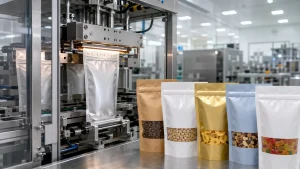
Short answer: Stable pouch sealing requires compatible packaging material and a repeatable process. Check the seal location, contamination, film presentation and operating conditions before changing settings. There is no single temperature that applies to every pouch or machine.
Identify the Package and the Affected Seal
A premade pouch machine closes an existing pouch, while a form-fill-seal machine also forms the package from roll film. Record whether the problem affects the top seal, an end seal or the longitudinal seal. The equipment and film paths involved differ.
Use the premade pouch and VFFS comparison if you are still defining the packaging process.
Pouch Sealing Troubleshooting Table
| Observation | Possible factors | Information to check |
|---|---|---|
| Weak or incomplete closure | Material compatibility, contamination or unsuitable sealing conditions. | Film structure, seal location and when the defect first appeared. |
| Distorted or damaged film at the seal | Heat, pressure or film presentation may be unsuitable. | Compare the damaged area with an accepted sample; avoid assuming more heat will help. |
| One part of the seal differs from another | Uneven contact or extra film layers may affect the result. | Photograph both sides and record whether the defect repeats in the same place. |
| Seal quality changes after a speed change | The available sealing time and handling conditions may have changed. | Record the old and new rate, settings and finished-pack results. |
| Product appears in the sealing area | Filling, product settling or package positioning may be involved. | Note the product, dose and whether the issue occurs consistently or intermittently. |
Confirm Material and Process Together
Keep the film supplier’s material specification with the trial record, including the intended seal layer and any recommended processing information. A film width or thickness alone does not establish sealing compatibility.
Review heat, contact pressure and sealing time together within the documented operating limits. Film feeding and product placement also affect how the layers meet. If a previously accepted setup becomes unstable, record what changed before selecting an adjustment.
Record a Repeatable Trial
Follow the machine manual and the film supplier’s recommendations. Mechanical inspection, cleaning and adjustment around heated or moving parts should be carried out by trained personnel using the specified shutdown and isolation procedure.
- Keep a labelled example of the defect and identify the affected seal.
- Record the product, film specification and batch, package dimensions, current settings and production rate.
- Change one permitted setting at a time and record the result against the original condition.
- Check a series of finished packs using the agreed seal or leak inspection method. A good-looking seal alone does not establish package integrity.
- Keep the accepted setup with the exact product and film combination; confirm it again after a material or format change.
Questions to Send with a Support Request
What evidence is useful?
Include the machine model, package dimensions, film specification, photographs of accepted and defective packs, current settings and a short description of when the issue occurs. State whether it began after a product, film, speed or format change.
Should every pouch use the same settings?
No. Confirm settings for the actual film structure, package and equipment. A setting from another machine is not a validated recipe for your production.
Which related equipment should I review?
For an existing-pouch project, review the SPK-500 premade pouch machine. For powder dosing and its connection to the packaging line, use the powder filling-system guide. For horizontal wrapping defects, see pillow packaging wrinkles and poor seals.